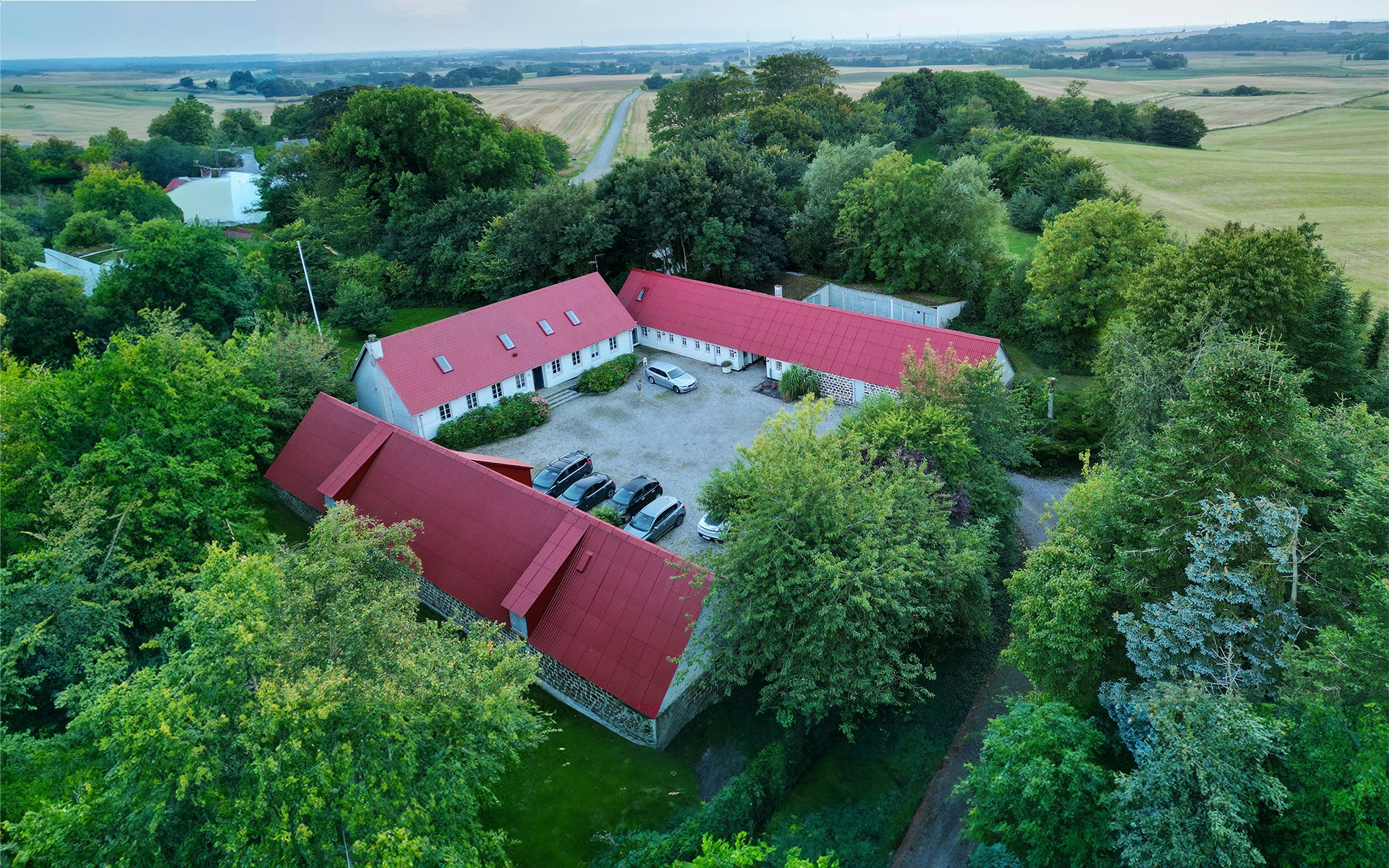
The Story of Kampehøjgaard
The story begins in 1870...
The short version
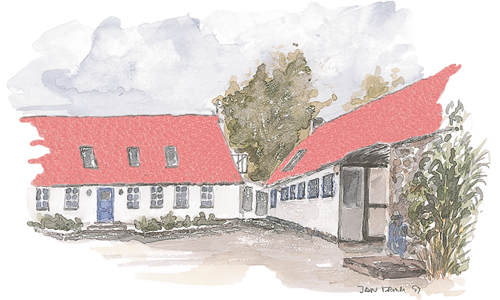
Overview
Kampehøjgaard and Vorre go back a long way. The farm lies in scenic surroundings in the highest-lying settlement, 117 meters above sea level.
- 1870 Kampehøjgaard is built
- 1974 Bought by Kjeld Lund Hansen (Kjeldsgaard)
- 1999 SuperUsers a/s buys Kjeldsgaard and renames it Kampehøjgaard
The early history of Kampehøjgaard
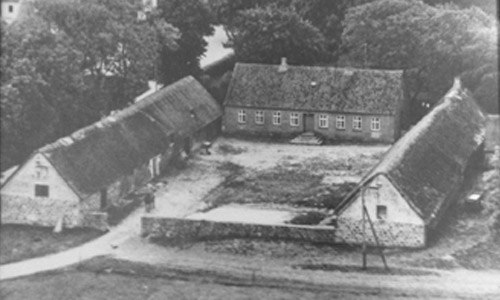
The farm was probably first built back in the 1800s and later underwent a number of alterations and modernizations in keeping with the standards of the time - the farm as we know it today was thus officially built in 1870. The main house was built of red brick with a tile roof. The wings were mainly built of fieldstone on a base of footing stones, meaning there was no actual foundation. That this was common at the time can clearly be seen in the surrounding farms.
Together with the other farms in Vorre, the properties belonged to the Vosnæsgård estate, and until corvée was abolished, the farmers had to perform corvée labor for the owners of Vosnæsgård.
It is striking how similar the various farms in Vorre originally were, including in their choice of materials. The reason is probably that, from the time they were built, they all had a common owner, namely Vosnæsgård. In addition, the materials, such as the large fieldstones from the surrounding fields, were close at hand, along with timber from the forests and bricks from the many brickworks in the area around Aarhus. The building style and choice of materials are also very common in the houses that still belong to Vosnæsgård.
The Rear Admiral
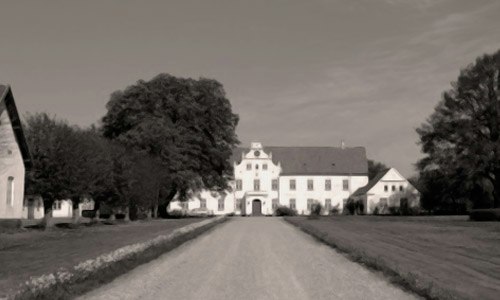
In 1835, Rear Admiral Johan Wilhelm Cornelius Krieger bought Vosnæsgård. He sold off large parts of the estate's tenant farms, as did his widow, Anne Sophie Krieger, who owned the estate until 1860. It is therefore reasonable to assume that the present-day Kampehøjgaard was one of the farms sold to a tenant farmer who worked the farm, making him an independent farm owner.
From then on, Kampehøjgaard operated as a farm with mixed livestock. The farm's land covered about 26 hectares. A man at the local history archive recounts that as a boy, around 1950, he and his father delivered pigs to the farmer there.
In the barn, you can still see traces of cows and milk churn storage.
You can also see several changes to the farm caused by a fire in the west wing. The changes made it possible to fit out more guest rooms and a butchery for game.
SuperUsers moves in in 1999
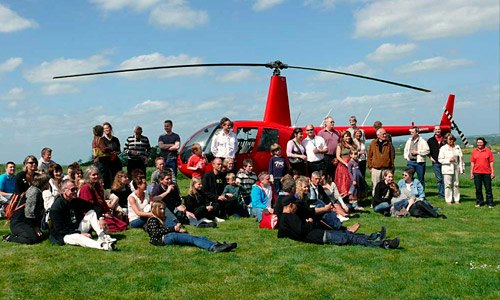
In 1974, the property was bought by Kjeld Lund Hansen for use as a private residence with associated commercial use. The farmland that came with it was leased out to local farmers. Within a short time, Kjeld Hansen dug a pond in one of the fields because he wanted to hunt released ducks, which was not particularly popular with the surrounding farmers.
In 1987, Kjeld Lund Hansen sold the farmland to Steen Knudsen, who owned Vorregård, the farm across the road. One of the conditions was that Kjeld Hansen kept the hunting rights on all the land, more than 100 hectares, for DKK 250 a year, a very symbolic price even back then.
Kjeld Hansen sold Kampehøjgaard to Brian Eberhardt in 1999, and that is where SuperUsers’ Jutland adventure begins.
Vortu Viking Village
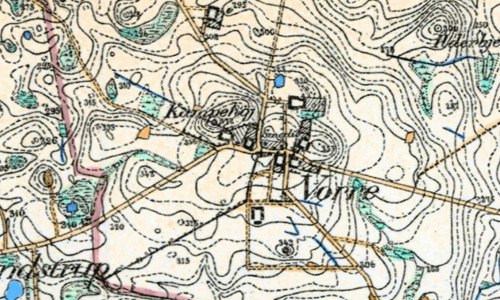
Vorre, or Vortu as it was called in the Viking Age along with the neighboring village of Segalt, has been known as far back as the 700s. Vortu was, and still is, located very high up (117 meters above sea level), a fact that people have made use of since the Bronze Age. The inhabitants of that time placed a burial mound on top of the natural hill that lies just beyond the garden of Kampehøjgaard. Today, it helps make Vorre the highest-lying contiguous settlement in Denmark.
In the Viking Age, Vortu was probably an important lookout point. In clear weather, you can see all the way to Samsø and Helgenæs. This meant that signal fires could be used to warn the town of Aros, now Aarhus, of approaching enemies, which was needed several times. Together with the nearby royal estates in Lisbjerg and Haldum, Vortu formed an effective warning system.
Later on, small fortifications were built on the outskirts of Vorre, in fact in the garden of the house across the street from Kampehøjgaard. The fortification is believed to have been used during the Count's Feud, but it may also have been used in the Second Schleswig War in 1864.
A rich town
There are still clear signs that Vorre was once a prosperous village with a school, a cooperative store, a dairy and craftsmen. In the 1800s, Vorre was sidelined when a railroad was built from Aarhus to Grenå, and the nearby town of Løgten took over as the commercial center, with many shops and light industry. As a result, Vorre's role as a town came to an end.
Fortunately, Vorre's residents have kept a number of traditions alive through the Residents' and Waterworks Association. One of the highlights of the year is still the general meetings, which are held jointly even though Vorre no longer has its own waterworks. What matters most is the party held afterward for all the residents of Vorre, parties that SuperUsers has also attended for several years.
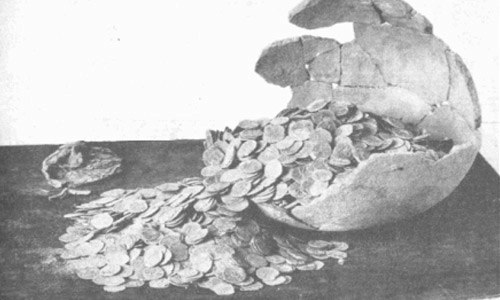
In 2005, a significant treasure of more than 3000 silver and copper coins was found in Vorre. Dating shows that they were minted in the time of Erik Klipping or Erik Menved, that is, between 1259 and 1319. Many of the coins come from Byzantium and were probably brought home by a nobleman who had been abroad. This is yet another sign that Vorre was a prosperous place.